
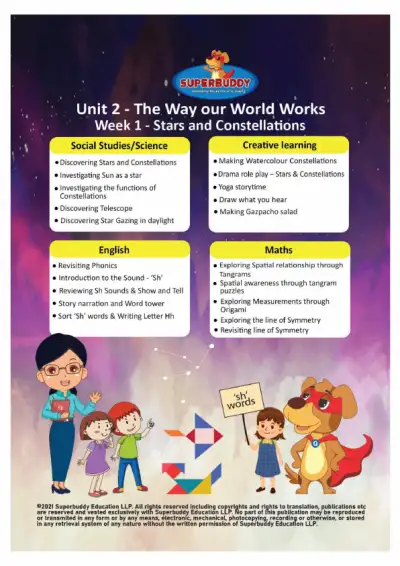
A 5-day lesson plan where children investigate what stars and constellations are, why the Sun appears larger and brighter than other stars, and how star patterns support navigation. Hands-on activities include painting, playdough modeling, and telescope making.
What children learn
- Describe stars and recognise constellations such as Orion and the Big and Little Dippers.
- Understand that the Sun is the closest star to Earth and provides heat and light.
- Explore how distance affects the apparent brightness and size of stars.
- Explain how stars and constellations have helped sailors, explorers, and astronomers navigate.
- Recognise a telescope as a tool for viewing distant objects in space.
Key activities
- Discovering Stars and Constellations with visual aids and playdough-and-toothpick models
- Creating Watercolour Constellations with star stickers and connected patterns
- Comparing the Sun and other stars, then classifying stars as faint, medium, or bright
- Investigating constellation navigation with punched cards and flashlights
- Constructing a model telescope from paper tubes and cups
- Daylight Star Gazing through model telescopes and constellation cards
You’ll need
constellation pictures and cards, playdough, toothpicks, chart paper, crayons and markers, watercolours and brushes, star stickers and cut-outs, flashlights, paper tubes and cups, scissors, glue, telescope
Structure: 5 days; each day: Thought of the Day, Tuning-in Time, Warm-up, Social Studies/Science, Creative Learning, English, Maths